Wedding Photography Slideshow

cavsi, Orlando, Florida What are Liquid microphones?

275 views | Posted in Uncategorized | Print Print | Email Email

Early microphones did not produce intelligible speech, until Alexander Graham Bell made improvements including a variable resistance microphone/transmitter. Bell’s liquid transmitter consisted of a metal cup filled with water with a small amount of sulfuric acid added. A sound wave caused the diaphragm to move, forcing a needle to move up and down in the water. The electrical resistance between the wire and the cup was then inversely proportional to the size of the water meniscus around the submerged needle. Elisha Gray filed a caveat for a version using a brass rod instead of the needle....

Contenido completo »


cavsi, Orlando, Florida What are Laser microphones?

263 views | Posted in Microphones | Print Print | Email Email

Laser microphones are often portrayed in movies as spy gadgets. A laser beam is aimed at the surface of a window or other plane surface that is affected by sound. The slight vibrations of this surface displace the returned beam, causing it to trace the sound wave. The vibrating laser spot is then converted back to sound. In a more robust and expensive implementation, the returned light is split and fed to an interferometer, which detects frequency changes due to the Doppler effect. The former implementation is a fun tabletop experiment; the latter requires an extremely stable laser and precise...

Contenido completo »


cavsi, Orlando, Florida What are Magnetic Microphones?

264 views | Posted in Microphones | Print Print | Email Email

Competing with carbon microphones were magnetic microphones that we know today as dynamic mics. A sound moves a small magnetic coil in and out of a magnetic field. This is just like a speaker except the moving coil makes electric current instead of an electric current making a coil move. The weight and size of the coil is the limiting factor in the quality of the music. A small coil makes for a much better quality microphone, but at a cost of ten times that of the carbon mic.

Variations on the dynamic mic are the Shure Controlled Reluctance element that works by moving an iron pin in...

Contenido completo »


cavsi, Orlando, Florida What are Condenser and Electret Microphones?

273 views | Posted in Microphones | Print Print | Email Email

Condenser microphones make use of a thin piece of metal foil that is stretched above another piece of metal, as the foil moves it changes the capacitance of the system. This can be detected and turned into a current. Condenser mics are cheap and easy to make and have a good response.

Electret mics are similar to condenser mics in that they create a capacitance between two pieces of metal foil, but there is a polarizing voltage, or fixed-charge, applied to the back plate when it is made which is permanent. Electret microphones can be tiny and are used in cell phones.


Temas Relacionados:

cavsi, Orlando, Florida What is Phantom Power?

263 views | Posted in Microphones | Print Print | Email Email

A convenient way to power a condenser microphone is with phantom power from a separate device. Phantom power uses the same cable that transports the audio signal out of the mic, to transport power to the mic. If you are able to provide phantom power to a microphone, you will not need batteries.

Phantom power capabilities are often built into mixers. You’ll likely be able to access it with an on/off switch on the mixer.

While it is intended for condenser microphones, if a dynamic microphone was accidentally fed phantom power, it would not damage the microphone.

Phantom...

Contenido completo »


cavsi, Orlando, Florida What are Dynamic Microphones?

248 views | Posted in Microphones | Print Print | Email Email

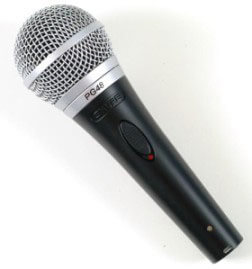
Dynamic microphones are also called moving-coil microphones.  Dynamic microphones tend to be heavier, larger, and less sensitive than most other types. They are extremely durable, dependable, and can withstand high sound pressure levels. Dynamic mics are versatile because they don’t require a power source. Because of these qualities, they are found in many applications.

Dynamic Microphone’s Working Procedure:

1. Sound waves hit the diaphragm of the mic.
2. The very sensitive diaphragm vibrates.
3. Vibrations move the coil of wire attached to the diaphragm.

Contenido completo »